Background checks used to require effort, money, or a job in law enforcement. Then they required a name, which is why people guarded their surnames on dating apps for years. Face search skips the name. A single photo, the one you chose because you looked good in it, is the whole query. Whatever the engine has indexed comes back attached to it: other photos, the pages they sit on, and from those pages, very often, everything else.

The new pre-date ritual
Talk to people who date and you hear the same sequence. Match, chat, exchange a photo or check the profile pictures, then run one of them through a face-search engine before agreeing to meet. Some do it for every date. Some only when something feels off. Many describe it as obvious common sense, in the same tone people once used for googling a name.
The difference from googling a name is the difference between a locked door and no door. A name search finds what a person has chosen to attach to their name. A face search finds every public image of that face, whoever posted it, whatever it was for, and reads the identity off the surrounding pages. It does not need the person’s cooperation, their real name, or their consent. It only needs the photo they sent you.
What the search actually returns
It is worth being concrete, because the imagined version and the real version are different. A face search does not return a dossier. It returns a set of images the engine believes contain the same face, each linked to the page it was found on. That is all. The dossier is what a motivated person assembles from those pages in the next few minutes.
A photo from a work event gives an employer. A photo on a local news site gives a town. A photo in a friend’s tagged album gives a real name and a social circle. An old profile on a site the person forgot about gives a previous relationship, a previous city, a previous self. None of these were offered. All of them were public, and the face was the key that unlocked them at once. We laid out the mechanics in why your face is a search term.
The results are also not always right. Face matching produces confidence scores, not certainties, and a search can return a stranger who happens to resemble you. On a first date that error has a particular shape: a person arrives to a conversation already coloured by something that was never about them.
The safety argument, honestly
It would be dishonest to write this post as if the search were always sinister. People, and disproportionately women, use it because meeting a stranger from the internet carries real risk, and checking that the person is who they say they are is a reasonable thing to want. Catfishing is real. So is worse. If a face search reveals that the photos belong to someone else entirely, it may have prevented harm.
We are not going to tell anyone to stop protecting themselves. What we would say is that the safety use and the surveillance use are the same button. The tool that confirms a date is genuine is the tool that lets a date find where you live, and it does not ask which one you meant. The person being searched has no way to know which motive is on the other side of the screen, which is exactly why the experience of being the search is so different from the experience of running it.
Two people, one search
Here is the imbalance that makes this different from mutual googling. Both people at the table sent a photo. Only the one whose face is indexed can be searched. If your face appears in a few clear, public photos that an engine has crawled, you are an open book to anyone with your picture. If it does not, the same search returns nothing, and you walk into dinner as the person you presented, with your history yours to share on your own schedule.
That is not about having something to hide. It is about the ordinary right to introduce yourself in the order you choose. The version of you from a decade ago, the job you left, the city you moved away from, the relationship that ended: those are all things a person might tell a partner in time. Face search hands them over before the drinks arrive, unsorted, without context, to someone whose judgement you have not yet had a chance to form.
Under the table
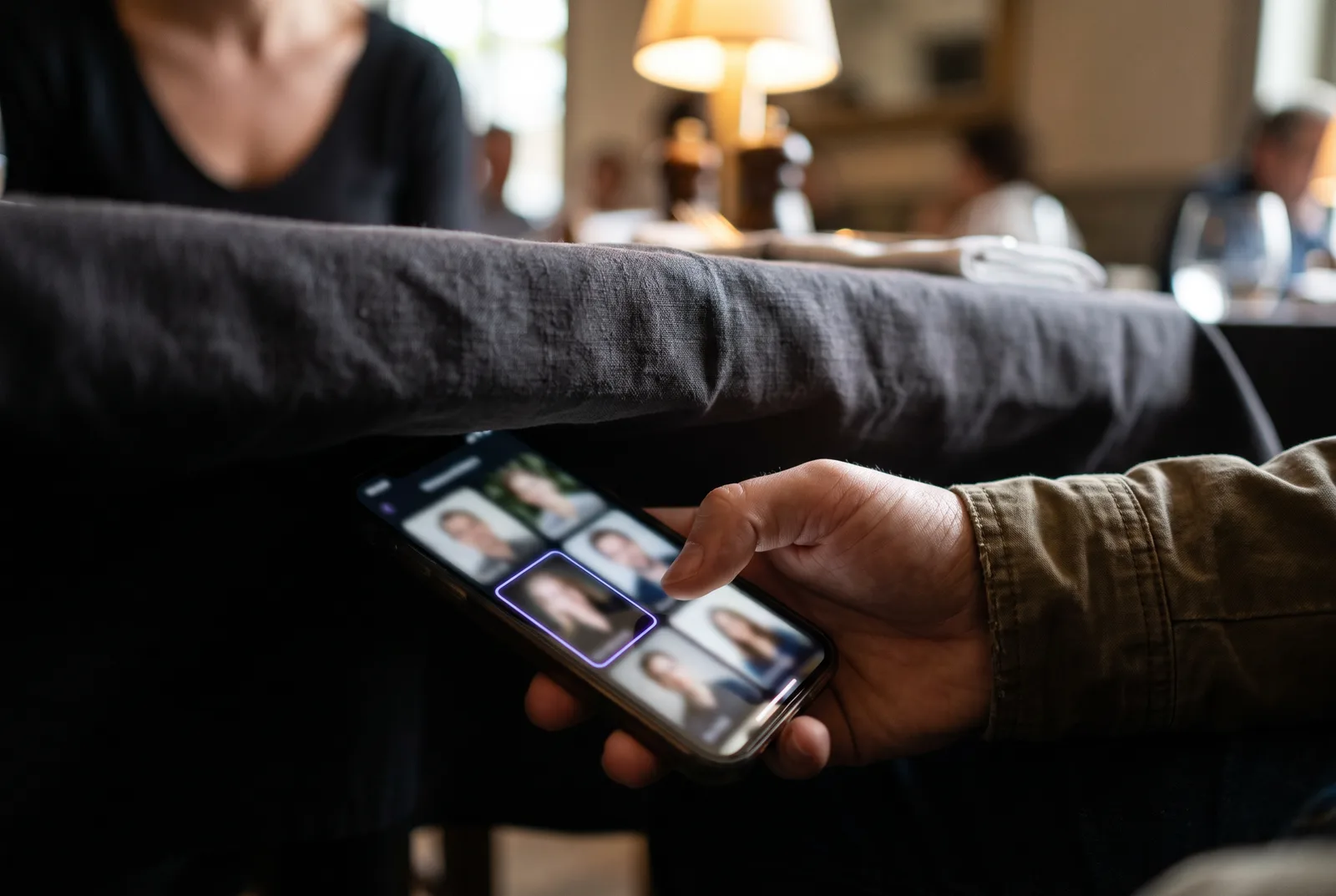
The pre-date search is at least a decision made calmly. The mid-date search is something else. A photo taken across the table, or a screenshot of a profile pulled up on the walk to the restroom, run through an engine between courses. People describe doing it when a story does not add up, or when they simply want to know more than they are being told. The other person, meanwhile, is talking about their weekend.
We mention this not to moralise but because it changes the picture of what you are protecting against. It is not one moment of vetting by a cautious stranger. It is the standing possibility that anyone who has ever seen your face can, at any time, for any reason, connect it to the rest of your life. That possibility is what a searchable face means, and dating is just where most people first feel it.
What you can control
You cannot control whether someone searches. You can control what the search returns. A face search only works because a small number of engines have indexed public photos of your face. Ask those engines to stop, and the photo you sent your date becomes what a photo used to be: a picture of you, with nothing attached.
That is the service FacePrivacy provides. We file opt-out and removal requests with the facial-recognition engines we support, on your behalf, and re-file them as necessary as the engines re-crawl. We cannot promise any engine’s response, and we do not delete the underlying photos from the sites that host them. What we work on is the index that turns your face into a way in. If you would rather tell your own story at your own pace, that is the thing to close.
Introduce yourself in the order you choose.
FacePrivacy files opt-out and removal requests with the major face-search engines on your behalf and re-files them monthly, so the photo you sent stays a photo.
Get started →